Written by Alyssa Gerace for ALFA Update
Senior living providers practice a variety of innovative techniques when managing aggressive behaviors that can be typical of residents with dementia, and they agree one of the biggest components is pro-activity.
Know Your Residents
This typically means knowing each resident and being familiar with their history and their patterns of behavior, says Janet Haynes, RN, director of clinical services at Endicott, N.Y.-based senior living and memory care management company Hearth Management.
“It’s important to know the resident themselves; it’s basically a traffic light of their behavior,” she says. “What gives you the ‘green light’ to be able to provide services and care for them? What is something you see change [that can be] a ‘yellow light’ or cautious sign? Or is there a ‘red light’ (or danger) where residents start exhibiting different patterns of behavior?”
At Silverado Senior Living, which exclusively operates memory care communities, each behavior is seen as a form of communication—including aggressive outbreaks.
“As professionals, it’s our job to try and understand [their] behavior and distinguish changes in it,” says Anne Ellett, NP, MSN, a senior clinical specialist with Silverado Senior Living.
Silverado staff, from executive directors to kitchen workers to housecleaners to caregivers and nurses, meet together to compile a history on each resident’s behavior and fill out ‘behavior intervention worksheets.’
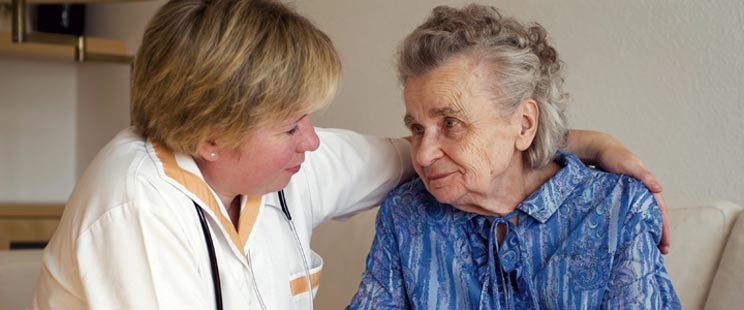 “What’s the pattern? What initiates it? What are the successful techniques for changing that behavior or altering it?” says Ellett as examples of how staff can understand what motivates certain behaviors. “What’s the pattern? What initiates it? What are the successful techniques for changing that behavior or altering it?” says Ellett as examples of how staff can understand what motivates certain behaviors.
The challenge, says Haynes, is consistent staffing, to help ensure the more subtle signs that might occur each day are communicated through a reporting system that channels information from day staff to evening and overnight staff. That’s key at Silverado, as well, where an interdisciplinary approach is taken.
Common Causes of Aggression and Treatments
“We all try to contribute information. Our nurses are very active in looking for acute illnesses or sources of pain, because it’s common that the elderly in general might be having pain, whether it’s a chronic condition like arthritis or they’re starting to get an upper respiratory infection or urinary tract infection,” Ellett says. “Be proactive rather than reactive.”
Often, what motivates an aggressive outbreak cannot be communicated by the resident, but sometimes it can be simple to address.
“You’ve got to find the trigger and remove it. Let’s say there is music playing during the meal, and someone gets agitated during mealtime, which can be very overstimulating for residents,” says Haynes. “If you see agitation, start decreasing some of their stimulus.”
That can be accomplished by eliminating the music, or by staff making sure they’re not talking too much.
 But it can be a longer process than merely removing a trigger, says Haynes. Another strategy is for caregivers to redirect a resident’s attention through distraction. But it can be a longer process than merely removing a trigger, says Haynes. Another strategy is for caregivers to redirect a resident’s attention through distraction.
One common source of agitation among residents with dementia is the desire to ‘go home.’ While a typical response could be to say, ‘No, this is your home, you live here now,’ it’s better to counter the behavior by asking other questions, Haynes says, avoiding the use of ‘why’ in favor of ‘how, where, what, and who,’ as dementia patients aren’t able to reason their behavior.
The conversation could be redirected by asking a resident, ‘Where is your home?’ to ‘What color is your house?’ to ‘Who lives with you? Do you have any pets?’ to guide the resident into past memories and distract them from their current agitation.
“You can usually de-escalate their aggression and anger, and redirect the conversation into a different topic that will diffuse their behavior,” says Haynes.
No "One Size Fits All" Solution
A plan formulated by Silverado staff was able to resolve recurring agitation for one resident who didn’t want to be at the community.
“Every time she started [displaying agitated behavior], we’d say, ‘We love you, Betty. You’re safe here, we’re so glad you’re here. We’re going to take good care of you.’ She started hearing that from everyone that walked by, and while she may not have comprehended all of that, she got the body language and the sense that she was safe and secure,” Ellett recalls.
Other distraction techniques include knowing each resident’s “rewards” and being able to offer it to them, whether it’s a piece of chocolate or going for a walk.
Putting together, analyzing, and understanding each resident’s behavioral patterns to come up with an appropriate plan of action can be time consuming, but it’s worth it, says Haynes.
“It sounds like a lot of work, but once you get to know the individual, it gets easier,” she says. “Once you figure out their triggers, then your success story starts: you can start programming around that resident’s mood and lift them out of it.”
|

When living at home is no longer an option... You need A Caring Place
Thursday, October 17, 2013
Memory Care Takes Proactive Approach to Manage Aggressive Behavior
Memory Care Takes Proactive Approach to Manage Aggressive Behavior

Tuesday, January 29, 2013
San Juan Villa
This short video takes you on a mini tour of the beautiful San Juan Villa memory care community in Port Townsend, Washington! San Juan Villa emulates our commitment to loving, thoughtful care. Take a look!
If you are interested in learning more about San Juan Villa, you can take a look at their website and facebook page.
Tuesday, January 8, 2013
Getting to Know You: Marcus Shields
There are so many wonderful individuals who work at our various communities. We've decided to begin spotlighting these individuals with a "Getting to Know You" piece on our blog.
Our guinea pig for this new spotlight is Marcus Shields, the new administrator at Hearthside Manor.
 What do you enjoy most about caring for senior residents?
 Tell us about Movember. When did you start participating?


Our guinea pig for this new spotlight is Marcus Shields, the new administrator at Hearthside Manor.
 |
| Marcus with his family in Seattle. (Left to right: Darla, Marcus, Turner, and Natalie) |
Tell us a little about yourself -
I was born and raised in Salt Lake City, UT and have recently moved to the Northwest. I have been married for 5 years and have 2 children (1 boy and 1 girl), who are 3 and 10 months old. I enjoy spending time with my family outdoors. I like boating, skiing, and running. I enjoy running and training for races. The last race I ran was the St. George Marathon last fall. I spent some volunteer time in Guatemala just after high school where I learned to love the Spanish culture and their language.
 What do you enjoy most about caring for senior residents?
I love spending time with the residents and getting to know them and see what kind of experiences they had in their life. Everyone has an incredible story to tell and I seem to be amazed the more I learn about the residents here at Hearthside Manor. The residents all come from such different backgrounds, cultures and have different experiences that has made them the person that they are today. I feel grateful for the opportunity to get to know them better.
You're new to Washington. What do you like about the area?
I love how green everything is up here in the Washington. It is a beautiful part of the country and I enjoy exploring on the weekends and going to see new places and areas all over the state.
 Tell us about Movember. When did you start participating?
Movember is an annual, month long, event involving the growing of mustaches during the month of November to raise awareness of prostate cancer and other male cancer and associated charities. The overall goal is to raise funds throughout the month and to change the face of men’s health. This is happening on a worldwide basis every year throughout the entire month of November. I have been participating with it for the last 3 years and will continue to do so in the future.
Anything else you want to add?
It is a pleasure to be working and living here in the wonderful state of Washington. I am excited to explore more and get to know more about the state and what it has to offer.


Link to Hearthside Manor's Facebook Page
Monday, December 31, 2012
Easthaven Villa's Volunteer Extraordinaire
Volunteer extraordinaire, Vickie McMaken, spends hours upon hours every week visiting the residents at Easthaven Villa. Vickie shares her story and what inspires her to give so much of her time at Easthaven. We are grateful for her love and desire to spend time with our residents.
Easthaven Villa is Located in Yelm, Washington.
Easthaven Villa is Located in Yelm, Washington.
Subscribe to:
Posts (Atom)